



A production line goes quiet at 2 a.m. because a compressor overheated, and nobody knew until the morning shift walked into a stopped conveyor and a missed shipment. A fleet of refrigerated trucks loses an entire batch of vaccines because a cooling unit drifted out of range somewhere between the warehouse and the hospital. A retail chain reorders inventory based on gut feel and last quarter’s spreadsheet, while shelves in three stores sit empty on a Saturday.
None of these are technology stories. They’re money stories. Downtime, spoilage, and stockouts show up directly on a P&L statement, and they tend to repeat until someone decides to fix the actual cause rather than the symptom.
This is why IoT application development has moved from an innovation-team side project to a boardroom conversation. It isn’t about putting a sensor on something because sensors are interesting. It’s about giving a business eyes and ears on operations that were previously invisible until something broke.
What’s changed in 2026 is the second half of the equation. Connected devices have existed for years, but raw sensor data sitting in a dashboard nobody checks isn’t worth much. What’s accelerating adoption now is the pairing of IoT with AI — machine learning models that can spot a failure pattern three weeks before it happens, or an agentic system that can reorder a part automatically instead of just flagging that stock is low. The connectivity layer solved “can we see the data.” AI is solving “can the data make decisions for us.”
This guide is written for the people who have to make that call: founders, CTOs, product managers, and operations leaders in manufacturing, healthcare, logistics, and retail who are trying to figure out whether an IoT initiative is worth the investment, what it actually takes to build one, and how to avoid the mistakes that quietly sink most IoT projects before they reach production. We won’t spend time defining acronyms you already know. We’ll walk through how these systems are actually built, what they cost to run, where they typically go wrong, and how to evaluate a development partner who can get you from idea to a working product. For businesses evaluating IoT application development, the right approach starts with a clear operational problem, a scalable technical architecture, and a measurable ROI target.
Key Takeaways
- IoT application development connects physical devices to software, analytics, and business workflows.
- The most valuable IoT applications solve a specific operational problem such as downtime, spoilage, stockouts, or delivery delays.
- A production-ready IoT solution typically combines devices, connectivity, cloud or edge computing, backend services, APIs, dashboards, analytics, and security.
- AI can extend IoT applications with predictive maintenance, anomaly detection, demand forecasting, computer vision, and automated decision-making.
- IoT development costs depend on device count, hardware complexity, connectivity, cloud infrastructure, integrations, security requirements, and ongoing maintenance.
- Businesses should validate an IoT pilot with a measurable business outcome before scaling across their organization.
Table of Contents
What Is IoT Application Development?
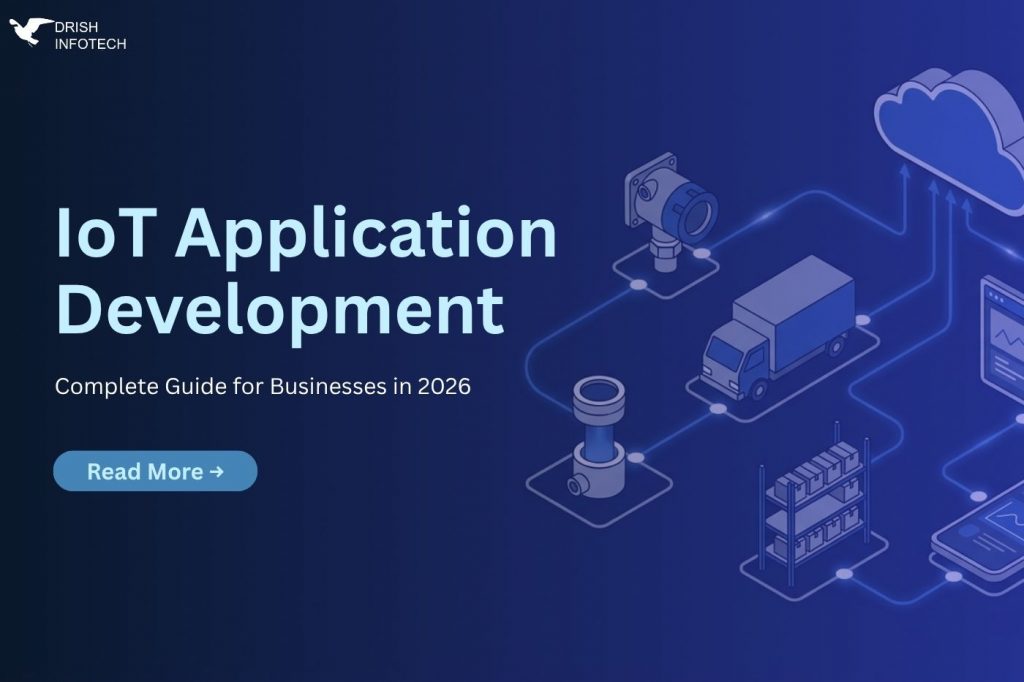
IoT application development is the process of connecting physical devices, sensors, and assets to software that collects, processes, and analyzes data to support automated or human-driven business decisions. At its core, IoT application development is the work of connecting physical assets — machines, vehicles, shelves, wearables, buildings — to software that can interpret what those assets are doing and help someone act on it. That’s the whole idea in one sentence. Everything else is implementation detail.
The ecosystem generally flows in one direction:
Devices (sensors that measure temperature, vibration, location, humidity, motion, or usage) → Connectivity (the network that carries readings from the device to the cloud — Wi-Fi, cellular, Bluetooth, LoRaWAN) → Cloud (where data is ingested, stored, and processed) → Analytics (rules engines or machine learning models that turn raw readings into meaning) → Dashboard (a mobile or web interface where a human sees what’s happening) → Business Decisions (a maintenance ticket gets created, a truck gets rerouted, a reorder gets placed).
A simple example makes this concrete. A cold storage warehouse installs temperature sensors in each unit. The sensors report readings over Wi-Fi every sixty seconds. Those readings land in a cloud database. A rule checks whether temperature has stayed above a safe threshold for more than five minutes. If it has, the dashboard shows a red alert, and a facility manager gets a push notification on their phone before an entire pallet of product spoils. That’s IoT application development — not a single piece of hardware, but the whole chain from a physical sensor to a decision a person actually makes.
What separates a well-built IoT application from a proof-of-concept that never scales is everything between the sensor and the decision. Anyone can plug a temperature sensor into a microcontroller and see numbers on a screen. Building something that stays online across thousands of devices, survives patchy connectivity, secures every data packet, and still makes sense to a warehouse manager who isn’t technical — that’s a software engineering problem, not a hardware problem, and it’s why IoT app development increasingly looks like any other serious custom software development engagement with an extra hardware layer bolted on.
An IoT application typically includes connected devices and sensors, connectivity, cloud or edge infrastructure, backend services, APIs, analytics, dashboards or mobile apps, and security controls.
Why Businesses Are Investing in IoT in 2026
The business case for IoT rarely starts with “we want to modernize.” It starts with a specific, quantifiable pain point, and the ROI conversation follows from there.
Operational efficiency. Visibility into how equipment, vehicles, or staff are actually being used almost always reveals waste that was invisible on paper. A logistics company might discover that 20% of truck idle time has nothing to do with traffic and everything to do with loading dock delays that a connected scheduling system could fix.
Predictive maintenance. Rather than fixing equipment on a fixed calendar schedule or waiting for it to break, sensors that monitor vibration, temperature, or current draw can flag a failing bearing or motor weeks in advance. Industry analysts including McKinsey and Deloitte have repeatedly pointed to predictive maintenance as one of the highest-ROI industrial IoT use cases, since unplanned downtime is consistently more expensive than the sensors and software required to prevent it.
Cost reduction. Energy monitoring, route optimization, and automated inventory counts all translate directly into lower operating costs, and unlike many technology investments, the savings are usually measurable within the first year.
Remote monitoring. For businesses with distributed assets — solar installations, remote pumps, rental equipment, cold chain fleets — IoT removes the need to physically inspect every asset on a schedule. A technician only needs to be dispatched when something is actually wrong.
AI integration. This is the newer driver. Businesses that have been collecting sensor data for years are now realizing that data has untapped value once it’s fed into a machine learning model. A retailer with years of foot traffic and inventory data can build demand forecasts far more accurate than manual planning ever allowed.
Sustainability. Energy and water usage monitoring helps organizations meet ESG reporting requirements with real data instead of estimates, which is increasingly a procurement requirement for enterprise contracts.
Better customer experience. Connected products — from fitness wearables to smart appliances — let companies understand actual usage patterns after the sale, not just at the point of purchase, which feeds directly into better product decisions.
Takeaway: the businesses that get the most out of IoT investment are the ones that start with a single, well-defined operational problem rather than a company-wide IoT strategy on day one. Prove the value on one production line, one delivery route, or one store location, then expand.
Common Types of IoT Applications
Manufacturing
Manufacturing remains the largest and most mature IoT use case, largely because the ROI is so direct. Sensors on production equipment track vibration, temperature, and cycle counts to catch failures before they cause a line stoppage. Asset tracking tags monitor tools and work-in-progress inventory across a plant floor, cutting down time spent searching for equipment. Quality control cameras paired with computer vision catch defects that are easy for a tired human eye to miss on a fast-moving line.
Business benefit: fewer unplanned stoppages, lower scrap rates, and maintenance budgets that are planned rather than reactive.
Healthcare
Remote patient monitoring devices track vitals like heart rate, glucose levels, and oxygen saturation, sending alerts to care teams when a patient’s readings drift outside a safe range — without requiring a hospital stay. Hospitals use asset tracking to locate mobile equipment like infusion pumps and wheelchairs, which otherwise consume enormous amounts of staff time. Cold chain monitoring for vaccines and medication ensures compliance with strict temperature regulations throughout transport and storage.
Business benefit: reduced hospital readmissions, faster equipment location times, and regulatory compliance that’s automatically documented rather than manually logged.
Logistics
Fleet telematics report vehicle location, driver behavior, fuel consumption, and maintenance needs in real time. Cold chain sensors protect perishable and pharmaceutical shipments. Warehouse IoT — from smart shelving to automated inventory scanning — cuts down the labor and error rate of manual stock counts.
Business benefit: better delivery time accuracy, fewer spoiled shipments, and measurably lower fuel and maintenance costs.
Retail
Smart shelves with weight sensors flag low stock automatically instead of relying on staff to notice. Foot traffic sensors and in-store cameras (used for aggregate analytics, not individual tracking) help retailers understand which layouts and displays actually drive purchases. Connected refrigeration in grocery and convenience formats prevents costly spoilage.
Business benefit: fewer stockouts, better-informed merchandising decisions, and reduced shrinkage.
Agriculture
Soil moisture and weather sensors let farms irrigate precisely instead of on a fixed schedule, cutting water usage substantially. Livestock tracking tags monitor animal health and location across large properties. Drone-based crop monitoring paired with computer vision identifies disease or pest pressure early enough to act on it.
Business benefit: reduced input costs (water, fertilizer) and earlier intervention on crop or livestock health issues.
Smart Cities
Connected streetlights dim or brighten based on actual pedestrian and vehicle activity, cutting municipal energy costs. Smart parking sensors direct drivers to open spots, reducing congestion caused by circling. Environmental sensors track air quality and noise levels to inform public health policy.
Business benefit: measurable reductions in municipal utility spend and improved resident quality-of-life metrics that matter for public funding cycles.
How IoT Applications Actually Work
It helps to walk through one complete example end to end rather than talk about the stages abstractly. Cold chain logistics is a good one, because every stage matters and the stakes of getting it wrong are obvious.
Sensor. A battery-powered temperature and humidity sensor sits inside a refrigerated container. It takes a reading every thirty seconds and holds it locally if there’s no connection available.
Gateway. Because cellular connectivity inside a shipping container can be unreliable, the sensor first talks to a gateway device over Bluetooth or a low-power wireless protocol. The gateway aggregates readings from multiple sensors in the same vehicle and handles the actual internet connection, usually over cellular.
Cloud. The gateway pushes batched readings to a cloud ingestion service — commonly AWS IoT Core or Azure IoT Hub — which authenticates the device, timestamps the data, and writes it into a time-series database built to handle high-frequency sensor data efficiently.
Analytics. A rules engine checks each reading against the safe temperature range for the specific cargo (vaccines and produce have very different thresholds). If a reading is out of range, or if a device stops reporting entirely, that’s flagged as an anomaly. More advanced setups layer a machine learning model on top that can predict, based on early temperature drift patterns, that a cooling unit is likely to fail in the next few hours — before the temperature has actually left the safe zone.
Dashboard. A logistics manager sees a live map of every shipment in transit, color-coded by status. An out-of-range alert triggers a mobile push notification, not just a dashboard color change, because the whole point is that someone needs to know immediately, not the next time they happen to check a screen.
Business action. The manager reroutes the shipment to the nearest facility with backup refrigeration, or dispatches a technician to intercept the vehicle. In a well-designed system, this can even be automated — the platform automatically notifies the nearest depot and generates a service ticket without waiting for a human to read the alert first.
That’s the full loop. Every IoT application, regardless of industry, is some variation of this same chain — the differences are in what’s being measured and how urgently a business needs to act on it.
Key Components of an IoT Application
| Component | Why It Matters |
|---|---|
| Devices | The physical hardware — sensors, actuators, embedded controllers — that interacts with the real world. Device selection affects battery life, cost per unit, and how much can be changed later without a hardware recall. |
| Sensors | The specific measurement units (temperature, GPS, accelerometer, pressure) that determine what data is even available to work with. Choosing the wrong sensor accuracy is one of the more expensive early mistakes. |
| Connectivity | The network layer moving data from device to cloud. Often the single biggest constraint on system design, since range, power consumption, and bandwidth all trade off against each other. |
| Cloud | Where data is ingested, stored, and processed at scale. Needs to handle bursty, high-frequency writes from potentially thousands of devices without falling over. |
| Backend | The application logic that processes incoming data, applies business rules, and stores results in a usable form. Most of the actual software engineering effort goes here. |
| APIs | The interfaces that let the mobile app, dashboard, and any third-party system (like an ERP) pull data out of the platform in a structured, secure way. |
| Mobile Apps | Give field staff and decision-makers access to alerts and data on the move, which matters enormously for use cases like fleet management or field service. |
| Web Dashboards | The primary interface for operations teams monitoring many devices at once — the visualization layer that turns numbers into decisions. |
| Security | Authentication, encryption, and access control across every layer. IoT devices are frequently the weakest link in an organization’s overall security posture. |
| Analytics | The rules engines and machine learning models that convert raw sensor data into meaningful signals — the difference between a number and a decision. |
Technologies Used in IoT Application Development
There’s no single “correct” tech stack for IoT — the right choice depends heavily on range requirements, power constraints, and existing infrastructure. That said, most projects draw from a fairly consistent set of proven technologies.
| Technology | Best Suited For | Notes |
|---|---|---|
| MQTT | Lightweight, low-bandwidth device-to-cloud messaging | The de facto standard messaging protocol for IoT; works well on constrained devices and unreliable networks |
| Bluetooth (BLE) | Short-range, low-power device communication | Ideal for wearables and sensor-to-gateway links; not suited for long range |
| Wi-Fi | Devices with access to consistent local network infrastructure | Higher power draw than BLE or LoRaWAN, but simple and fast to implement |
| 5G / Cellular | Mobile assets, remote locations without Wi-Fi | Higher cost per device, but essential for vehicles, remote field equipment, and cold chain shipments |
| AWS IoT Core | Large-scale, cloud-native IoT deployments | Strong device management and integration with the broader AWS ecosystem |
| Azure IoT Hub | Enterprises already standardized on Microsoft’s cloud | Deep integration with Azure’s AI and analytics tooling |
| Node.js | Backend services handling high volumes of concurrent device connections | Well suited to the event-driven nature of IoT data streams |
| Python | Data processing, analytics, and machine learning pipelines | The dominant language for the analytics and ML layer of an IoT stack |
| Flutter | Cross-platform mobile dashboards | Single codebase for iOS and Android, useful when budget or timeline is tight |
| React Native | Cross-platform mobile apps with native-feeling performance | A strong alternative to Flutter, particularly for teams with existing React expertise |
| Docker | Packaging backend services for consistent deployment | Standard practice for any modern backend, IoT or otherwise |
| Kubernetes | Orchestrating backend services at scale | Becomes relevant once device counts and data volume grow beyond a simple server setup |
| Edge Computing | Processing data on-site rather than sending everything to the cloud | Reduces latency and bandwidth costs, critical when connectivity is unreliable |
| AI / Machine Learning | Predictive maintenance, anomaly detection, forecasting | The layer that turns historical sensor data into forward-looking business decisions |
Takeaway: the technology stack should be chosen based on the specific constraints of the use case — power budget, connectivity environment, and data volume — not based on what’s trending. A cold chain sensor in a shipping container and a smart shelf sensor in a well-connected retail store have almost nothing in common in terms of ideal connectivity choice, even though both are “IoT.”
IoT Application Development Process
Discovery. Before any hardware or code decisions get made, the real work is defining the specific business problem and the metric that will prove the solution worked. Skipping this stage is the single most common reason IoT pilots stall out.
Planning. Scoping which devices, data points, and integrations are actually needed for a minimum viable version — not the full long-term vision, but the smallest version that proves value.
Architecture. Designing how data will flow from device to decision, including where processing happens (on the device, at the edge, or in the cloud) and how the system will scale as device count grows.
Hardware selection. Choosing sensors, gateways, and connectivity that match the physical environment — temperature range, power availability, existing infrastructure, and cost per unit at the target device count.
Prototype. Building a working version with a small number of devices to validate the concept in a real environment before committing to a full rollout.
Firmware. Writing the low-level software that runs on the device itself, handling sensor readings, local storage during connectivity gaps, and secure communication.
Backend. Building the cloud services that ingest, store, and process incoming data, and that expose it securely to the mobile app, dashboard, and any other system that needs it.
Mobile app. Developing the interface field staff and managers use to receive alerts and act on them — often the part of the system users interact with the most, even though it’s built last.
Dashboard. Building the web-based interface for teams monitoring many devices or a full fleet at once, typically with more detailed reporting and configuration capability than the mobile app.
Testing. Validating the system under real-world conditions — including poor connectivity, sensor failure, and high device volume — not just the happy path in a controlled office environment.
Deployment. Rolling out to production, typically in phases rather than all at once, to catch issues while the blast radius is still small.
Maintenance. Ongoing device monitoring, firmware updates, and platform improvements. IoT systems have a longer post-launch tail than typical software projects because physical hardware in the field needs monitoring that a purely digital product doesn’t.
One practical note from experience: teams that try to build the “complete vision” in a single release almost always take longer and ship something less reliable than teams that get twenty devices running well first, then scale. The complexity of an IoT system grows non-linearly with device count, not linearly, so validating architecture decisions at small scale before committing to them at large scale saves real money.
IoT Security Challenges Businesses Must Prepare For
IoT devices are frequently the least secure part of an otherwise well-protected network, mostly because they’re built with tight cost and power constraints that leave little room for heavyweight security software. That doesn’t mean security has to be an afterthought — it means it has to be designed in deliberately from the start.
Device authentication. Every device needs a unique, verifiable identity so the platform can distinguish a legitimate sensor from a spoofed one. Shared credentials across an entire device fleet are a common and costly shortcut to avoid.
Encryption. Data should be encrypted both in transit and at rest. This sounds obvious, but constrained devices sometimes skip encryption to save processing power and battery — a trade-off that needs to be a conscious decision, not a default.
Secure APIs. Every API that exposes device data needs proper authentication and rate limiting, since these endpoints are a common attack surface once a platform scales.
Firmware updates. Devices deployed in the field need a secure, reliable way to receive updates remotely. Without this, a discovered vulnerability means physically visiting every device — which, for a fleet of thousands, isn’t realistic.
Access control. Not every user or system needs access to every device or data stream. Role-based access limits the damage if any single credential is compromised.
Network segmentation. IoT devices should generally sit on a separate network segment from core business systems, so a compromised sensor can’t become a path into more sensitive infrastructure.
Compliance. Healthcare (HIPAA), payment (PCI-DSS), and general data protection regulations (GDPR and similar regional laws) all have implications for how IoT data is collected, stored, and transmitted — this needs to be part of the architecture conversation, not a legal review after the fact.
Zero Trust. Rather than assuming anything inside the network perimeter is safe, a Zero Trust approach verifies every device and request regardless of where it originates — an increasingly standard practice as IoT fleets grow larger and more distributed.
Takeaway: none of this is about fear-mongering. It’s about treating security as a design requirement with the same priority as functionality, because retrofitting security onto an IoT fleet already deployed in the field is far more expensive than building it in from day one.
AI and IoT: Why They Work Better Together
IoT generates the data. AI is what makes that data actually useful for decisions rather than just historical record-keeping. Companies that have been collecting sensor data for years without an analytics layer are often sitting on a substantial, underused asset.
Predictive maintenance. Machine learning models trained on historical sensor data — vibration patterns, temperature trends, current draw — can identify the early signature of a failure days or weeks before it happens, well before a simple threshold-based alert would trigger.
AI-powered analytics. Rather than a human reviewing dashboards looking for trends, models can continuously scan incoming data for patterns that would take a person far longer to notice, and surface only the signals that matter.
Computer vision. Cameras paired with vision models handle quality inspection, safety monitoring, and inventory counting at a speed and consistency no manual process can match.
Agentic AI. This is where things are heading in 2026 — rather than a model simply flagging an anomaly for a human to act on, an AI agent can take the next step itself: automatically generating a maintenance ticket, reordering a part, or rerouting a shipment, with a human only stepping in for exceptions rather than every routine decision.
Demand forecasting. Historical IoT data — foot traffic, machine usage, seasonal sensor patterns — feeds directly into far more accurate demand models than manual forecasting ever achieved.
Anomaly detection. Rather than defining every possible failure mode in advance with fixed rules, models trained on normal operating patterns can flag anything that deviates from “normal,” including failure modes nobody thought to write a rule for.
In our experience, the projects that get the most value from this combination are the ones that don’t try to bolt AI on after the IoT platform is already built. Designing the data collection strategy with the eventual analytics use case in mind — capturing the right frequency, the right sensor types, enough historical data — makes the AI layer dramatically more effective later, and retrofitting it after the fact is one of the more common regrets teams share once a platform is a year or two old. This is the same reasoning behind broader AI application development work: the value comes from the data pipeline feeding the model well, not just the model itself.
Cost of IoT Application Development
There’s no honest single number here, and any IoT vendor quoting a fixed price before understanding your specific use case is worth being skeptical of. What determines cost is a fairly consistent set of variables:
- Number of devices — cost per device typically drops at scale, but total hardware spend obviously scales with fleet size.
- Hardware complexity — a basic temperature sensor costs far less than a multi-sensor unit with GPS, cellular connectivity, and a long battery life requirement.
- Backend architecture — a system handling ten devices reporting hourly has vastly different infrastructure needs than one handling ten thousand devices reporting every few seconds.
- Cloud costs — data ingestion, storage, and processing costs scale with data volume and retention requirements.
- Security requirements — compliance-heavy industries like healthcare and finance require more extensive security architecture, which adds development time.
- Integrations — connecting the IoT platform to existing systems (an ERP, a CRM, a legacy maintenance system) adds scope that’s easy to underestimate.
- Mobile apps and dashboards — building for both iOS and Android, or a highly polished dashboard with advanced reporting, adds meaningfully to timeline and cost.
- Maintenance and support — ongoing device monitoring, firmware updates, and platform improvements are recurring costs to budget for beyond the initial build.
The honest answer to “what will this cost” is: it depends on the scope of the pilot, the industry’s compliance requirements, and how much of the vision needs to exist in version one versus later phases. A serious development partner should be asking about your specific constraints before offering a number, not quoting a range off a website.
Common Challenges During IoT Development
Connectivity. Real-world environments — warehouses with metal shelving, remote agricultural land, moving vehicles — rarely match the clean connectivity assumptions made in a lab. Building in local data storage and graceful reconnection handling from day one avoids painful rework later.
Scalability. A system that works cleanly with fifty test devices can behave very differently at five thousand. Architecture decisions made for a pilot don’t always hold up at production scale, which is why load testing against realistic device counts matters before a full rollout.
Battery life. For battery-powered devices, every additional feature or higher reporting frequency shortens field life, and replacing batteries across a large deployed fleet is expensive and disruptive. Getting the reporting frequency right for the actual use case matters more than it seems at first.
Legacy integration. Many businesses need IoT data to flow into decades-old ERP or SCADA systems that weren’t designed with modern APIs in mind. This is often the most underestimated part of a project timeline.
Security. As covered above — designing it in from the start rather than retrofitting it later.
Device management. Tracking device health, pushing firmware updates, and handling devices that go offline or get physically replaced requires dedicated tooling, not an afterthought spreadsheet.
Testing. Simulating real-world conditions — poor connectivity, sensor failure, extreme temperatures — is harder than testing typical software, and skipping it is one of the more common reasons pilots fail once they hit production conditions.
Compliance. Especially in healthcare and finance, regulatory requirements need to shape the architecture from the beginning rather than being checked at the end.
Takeaway: most of these challenges share a common thread — they’re expensive to fix after the fact and cheap to design around up front. Many organizations discover during implementation that the hardest part of an IoT project isn’t the sensors or the cloud infrastructure — it’s the unglamorous middle layer of connectivity handling, device management, and legacy integration that determines whether the system actually holds up in daily operation.
How to Choose an IoT Application Development Company
A practical checklist for evaluating a potential development partner:
- Technical expertise — can they speak fluently about connectivity trade-offs, edge computing, and cloud architecture, not just app development?
- Industry experience — have they built for your specific industry’s regulatory and operational constraints (healthcare, manufacturing, logistics)?
- Cloud knowledge — do they have real, demonstrable experience with AWS IoT, Azure IoT, or Google Cloud IoT, not just general cloud hosting?
- Security practices — do they treat device authentication, encryption, and secure firmware updates as core requirements rather than optional add-ons?
- Communication — will you get direct access to the engineers building your system, or only account managers relaying information?
- Portfolio — can they show real, working IoT deployments, not just mockups or slide decks?
- Scalability planning — do they design for your five-year device count, or only the pilot?
- Long-term support — do they offer ongoing maintenance and device monitoring after launch, or is delivery the end of the relationship?
- Integration capability — can they connect the new platform to your existing ERP, ticketing, or legacy systems without a separate, expensive engagement?
Drish Infotech has approached IoT and connected software projects the same way we approach any custom software development engagement — starting with the business problem, not the hardware catalog. Our work across mobile app development and AI application development means the mobile, dashboard, and analytics layers of an IoT platform are built by teams who’ve solved these problems before, not learning on your production system for the first time.
Future Trends
Edge AI. Running machine learning inference directly on the device or gateway, rather than sending every reading to the cloud, cuts latency and reduces bandwidth costs — increasingly important as device counts grow.
TinyML. Machine learning models small enough to run on extremely low-power microcontrollers, opening up intelligent processing on devices that previously couldn’t support it.
Digital Twins. Virtual replicas of physical assets or entire facilities, updated in real time from IoT data, letting teams simulate changes before making them in the physical world.
Private 5G. Enterprises with large facilities are increasingly deploying private 5G networks for more reliable, higher-bandwidth device connectivity than public networks or Wi-Fi can offer.
Agentic AI. As covered earlier, systems that don’t just flag issues but take the next action themselves — within carefully defined boundaries — are moving from experimental to production use.
Autonomous systems. In logistics and manufacturing particularly, IoT-connected autonomous equipment (guided vehicles, drones for inventory checks) is becoming more common as the underlying sensor and AI technology matures.
Predictive analytics. Moving beyond “alert when something breaks” to “predict what will need attention next quarter,” shifting IoT from an operational tool to a planning tool.
Sustainable IoT. Energy-efficient device design and smarter power management are becoming selection criteria in their own right, not just cost considerations, as sustainability reporting requirements tighten.
None of these trends make the fundamentals in this guide obsolete — they extend the same chain (device to connectivity to cloud to decision) with smarter processing at each stage. Businesses evaluating IoT today should build a solid foundation first; these are the layers that get added once that foundation is proven, not shortcuts around it.
Frequently Asked Questions
How long does it take to build an IoT application?
A focused pilot with a small number of devices and a clear scope typically takes a few months from discovery to a working production version. Full enterprise rollouts across thousands of devices, with deep legacy integrations, understandably take longer. The timeline depends far more on integration complexity and compliance requirements than on the number of devices involved.
Do we need to build our own hardware?
Not usually. Most IoT projects use commercially available sensors and gateways rather than custom-designed hardware, since custom hardware development adds significant time and cost. Custom hardware becomes worth considering only when off-the-shelf options genuinely can’t meet a specific requirement, such as an unusual form factor or an extreme environmental condition.
What connectivity option is right for our use case?
It depends entirely on the environment. Devices with access to reliable local infrastructure often do well on Wi-Fi. Mobile or remote assets typically need cellular connectivity. Short-range, low-power sensors often use Bluetooth or a protocol like LoRaWAN. A good development partner will assess your specific physical environment before recommending a connectivity approach.
How do we know if IoT is worth the investment for our business?
Start with a specific, measurable problem — unplanned downtime, spoilage, stockouts, delivery delays — and estimate what that problem currently costs annually. If a pilot targeting that single problem can plausibly pay for itself within a reasonable timeframe, that’s a strong signal the broader investment is worth pursuing.
Can IoT data integrate with our existing ERP or business systems?
Yes, this is standard practice, though the complexity varies significantly depending on how modern your existing systems are. Legacy systems without modern APIs typically require a middleware layer to bridge the gap, which should be scoped explicitly rather than assumed to be simple.
What’s the difference between IoT application development and just buying an off-the-shelf IoT platform?
Off-the-shelf platforms can be a reasonable starting point for very standard use cases, but they tend to become limiting once a business needs specific workflows, custom integrations, or analytics tailored to their particular operation. Custom IoT application development trades some upfront speed for a system built precisely around your business rather than a generic template.
How important is AI to an IoT project from day one?
It doesn’t have to be built in the first version, but the data collection strategy should be designed with future analytics in mind from the start. Retrofitting the right data granularity and history after the fact is far harder than planning for it up front, even if the AI layer itself comes in a later phase.
What ongoing costs should we expect after launch?
Cloud infrastructure costs that scale with device count and data volume, device connectivity fees (particularly for cellular-connected devices), and ongoing development for maintenance, firmware updates, and feature improvements. Budgeting for these as an ongoing line item, not a one-time cost, avoids unpleasant surprises a year into the deployment.
Is IoT security something we need specialized expertise for, or can our existing IT team handle it?
IoT introduces security considerations — device-level authentication, firmware update security, constrained-device encryption — that are meaningfully different from standard IT security. Existing IT teams are usually well equipped for the cloud and network side, but device-level security expertise is worth specifically vetting for in a development partner.
How do we avoid our IoT pilot becoming one of the projects that never makes it past testing?
Define a single, specific success metric before starting, keep the pilot scope small enough to actually finish, and involve the actual end users (technicians, warehouse staff, drivers) in testing before declaring success. Pilots that try to prove ten things at once, or that skip real-world testing conditions, are the ones that most often stall.
Conclusion
The businesses that get real value out of IoT are rarely the ones chasing the most advanced technology stack. They’re the ones that started with an honest, specific business problem — a maintenance cost that kept recurring, a shipment that kept arriving spoiled, a shelf that kept sitting empty — and built just enough connected software to solve it, then expanded from there once the value was proven.
IoT application development, done well, isn’t a technology initiative bolted onto a business. It’s an operational improvement that happens to run on sensors and cloud software. The organizations that treat it that way tend to end up with systems that actually get used, rather than dashboards nobody checks after the first month.
If your team is weighing an IoT investment and trying to figure out where to start — which problem to target first, what a realistic pilot looks like, or how AI fits into the picture — that’s a conversation worth having before any hardware gets ordered. Drish Infotech has spent over two decades building custom software for real operational problems, and we’d be glad to talk through what a focused, well-scoped IoT pilot could look like for your business. Get in touch to start that conversation.
Get in Touch
Contact us