


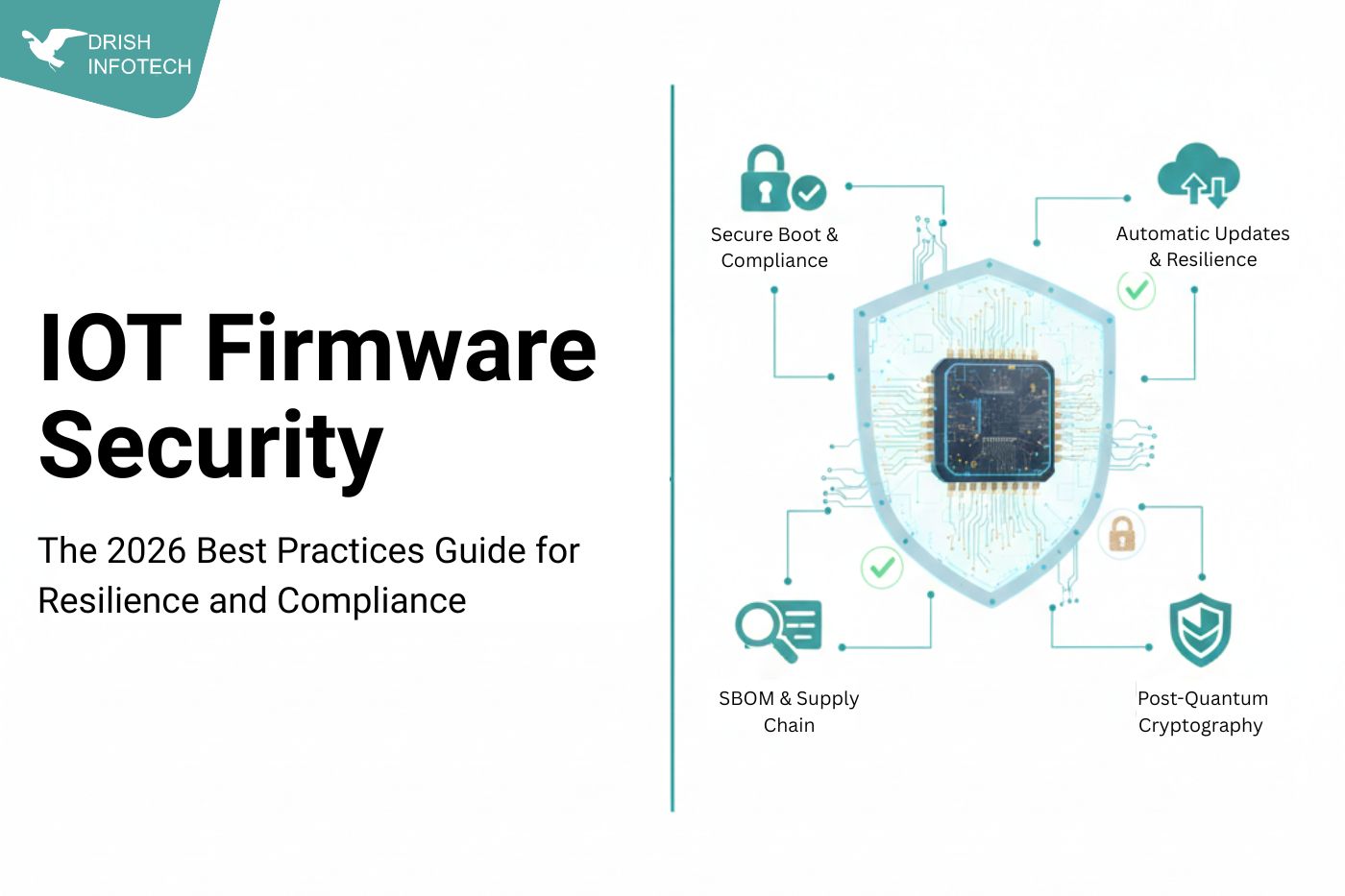

A Complete Guide to Securing Connected Devices in the Era of EU Cyber Resilience Act
The Internet of Things landscape in 2026 is vastly different from just a few years ago. With over 21,500 Common Vulnerabilities and Exposures (CVEs) disclosed in the first half of 2026 alone, IoT firmware security has emerged from the shadows of software development priorities to become a mission-critical requirement for manufacturers, developers, and enterprises worldwide.
The stakes have never been higher. IoT devices now constitute 30% of all network-connected endpoints, and with cybercrime costs predicted to exceed $20 trillion by 2026, representing 150% growth from 2022, firmware vulnerabilities are no longer acceptable technical debt—they’re existential business risks. Adding urgency to this reality, the European Union’s Cyber Resilience Act entered into force in December 2024, with critical reporting obligations beginning September 11, 2026, and full enforcement by December 11, 2027.
1. The Critical State of IoT Firmware Security in 2026
Why Firmware Security Matters More Than Ever
Firmware operates at the intersection of hardware and software, making it uniquely difficult to secure. Unlike application-layer software that can be patched with relative ease, firmware vulnerabilities persist because:
- Resource constraints in embedded systems limit the implementation of additional protection mechanisms
- Non-iterative implementation cycles make it difficult to eliminate vulnerabilities after market release
- Internet-readiness of devices makes exploitation more streamlined and straightforward
- Traditional cybersecurity solutions often cannot run on IoT hardware due to limited computing power
The Top Firmware Vulnerabilities Threatening IoT Devices
Based on recent vulnerability research and real-world attack patterns, these are the most critical firmware security threats facing IoT devices in 2026:
- Remote Code Execution (RCE): Allows attackers to gain complete control of devices, create botnets, steal data, or engage in espionage. RCE vulnerabilities remain the most feared firmware security threat.
- Authentication Bypass: Default or weak passwords and logical bugs enable attackers to access devices without proper credentials. Despite being well-documented, default password vulnerabilities remain the most prevalent issue.
- Buffer Overflows: Occur when programs store more data in a buffer than intended, allowing attackers to overflow adjacent memory locations with malicious code.
- Injection Flaws: Enable injection of malicious code through unsecured inputs or interfaces like web forms or APIs.
Insecure OTA Updates: Poorly implemented over-the-air updates can allow hackers to inject malicious code directly into devices.
2. Understanding the 2026 Regulatory Landscape
The EU Cyber Resilience Act: What You Need to Know
The EU Cyber Resilience Act (CRA) represents the most comprehensive cybersecurity regulation for IoT and embedded devices to date. Here are the critical deadlines and requirements:
- December 10, 2024: CRA entered into force
- September 11, 2026: Vulnerability and incident reporting obligations begin. Manufacturers must report actively exploited vulnerabilities to ENISA within 24 hours
December 11, 2027: Full CRA enforcement. All products with digital elements must comply with essential cybersecurity requirements
Core CRA Requirements for IoT Firmware
The CRA mandates specific technical requirements for IoT devices:
- Secure Boot Implementation: Devices must verify firmware integrity before execution using cryptographic signature verification
- Secure Default Configuration: No fixed default passwords—each device must have unique credentials
- Lifecycle Security Updates: Manufacturers must address vulnerabilities throughout device lifecycle with automatic OTA updates where applicable
- Software Bill of Materials (SBOM): Machine-readable inventory of all firmware components including dependencies, required for 24-hour vulnerability reporting
- Security-by-Design: Security must be integrated from the planning phase, not added as an afterthought
3. Secure Boot: The Foundation of IoT Firmware Security
What is Secure Boot?
Secure Boot is the process where operating system boot images and code are authenticated against the hardware before being authorized in the boot process. It establishes a root of trust that prevents adversaries from compromising the operating system or installing malicious bootloaders.
Think of Secure Boot as a series of validation layers that mutually check each other when a device powers on. Each phase must be verified for authenticity before proceeding to the next, creating an unbreakable chain of trust.
How Secure Boot Works
The Secure Boot process follows these critical steps:
- Key Provisioning: During manufacturing, a public key is embedded in secure storage on the device. The corresponding private key is kept securely by the manufacturer and never revealed.
- Firmware Signing: The bootloader code is developed using secure practices, and a cryptographic hash is digitally signed with the manufacturer’s private key.
- Boot-Time Verification: When the device boots, the hash signature is checked against the embedded public key. The firmware code is then hashed and compared with the signed hash.
- Chain of Trust: If verification succeeds, the bootloader checks and validates the operating system and application code before execution.
- Failure Handling: If any verification fails, the device refuses to boot, preventing malicious code execution.
Critical Implementation Requirements
For effective Secure Boot implementation in 2026:
- Use Hardware Security Modules (HSM) or Trusted Platform Modules (TPM) for cryptographic key storage
- Implement ARM TrustZone or equivalent technology to separate secure device functions from the operating system
- Use encrypted flash to prevent chip removal and content reading
- Implement version monotonicity to prevent downgrade attacks to known-bad builds
- Support key rotation with secure quorum policies for long-term device management
Important: Microsoft Secure Boot Certificate Updates
A critical update affects Windows-based IoT devices: Current Microsoft Secure Boot certificates will begin expiring in June 2026 and expire completely by October 2026. Organizations must update to the 2023 certificates before expiration to maintain security compliance. For OT and IoT environments, this requires longer testing and validation cycles—waiting until 2026 will be too late.
4. Secure Over-the-Air (OTA) Firmware Updates
Why OTA Security is Critical
Over-the-air firmware updates are one of the most powerful tools in modern IoT development—and one of the most dangerous if implemented poorly. Without proper security, OTA updates can expose systems to cyberattacks, device takeovers, or complete network failures.
OTA updates enable manufacturers to:
- Patch security vulnerabilities quickly without truck rolls
- Add new features and improve performance remotely
- Extend product lifecycle and reduce operational costs
- Meet regulatory requirements for timely security patching
Essential OTA Security Best Practices
- Cryptographic Signing and Verification
Public-key signatures on firmware artifacts with devices verifying using a public key burned at manufacture. Use offline private keys stored in HSMs or sealed vaults. Implement hash trees or signed manifests listing all component images with digests and sizes.
- Transport Layer Security
Use TLS 1.3 for encrypted channels between update servers and devices. Implement mutual TLS with device certificates to prevent unauthorized clients. Pin CA or server public keys to avoid trusting compromised system stores.
- Dual-Bank or A/B Partitioning
Maintain two complete firmware images. Write updates to the inactive partition and atomically switch on successful verification. This prevents bricked devices from failed updates and enables instant rollback.
- Delta Updates
For bandwidth-constrained environments, implement delta updates containing only differences between current and new firmware. This reduces package size and network strain while maintaining security through signature verification.
- Staged Rollouts with Monitoring
Deploy updates in phases starting with small test groups. Monitor metrics like installation success rates, boot failures, and crash reports. Implement automatic rollback if failure thresholds are exceeded.
- Resilience Testing
Build test rigs that simulate real-world chaos: random power cuts during updates, network interruptions, memory corruption. Script hundreds of failure scenarios to prove the update process is idempotent and recoverable.
5. Software Bill of Materials (SBOM) for IoT Firmware
Why SBOMs Are Now Mandatory
The EU Cyber Resilience Act explicitly requires manufacturers to identify and document vulnerabilities and components in firmware, including drawing up a Software Bill of Materials in a commonly used and machine-readable format. This isn’t optional—it’s mandatory for the 24-hour vulnerability reporting requirement starting September 11, 2026.
An SBOM is a formal, machine-readable inventory of software components and dependencies, their hierarchical relationships, and information about those components. For IoT firmware, think of it as an official ingredient list that reveals what’s actually running inside your device.
The Complexity of Firmware SBOMs
Creating SBOMs for IoT firmware is significantly more complex than for traditional software applications:
- Firmware is not a single program but a complex system of programs including libraries, operating systems, bootloaders, and configuration files
- Traditional AppSec tooling creates incomplete SBOMs because it won’t find recompiled or modified libraries
- IoT firmware often uses stripped binaries with symbol tables removed to save space, making version identification difficult
- Custom file systems like SquashFS, JFFS2, or UBIFS require specific unpacking tools
- Standard package manager queries are impossible on embedded systems
SBOM Standards and Formats
Industry-accepted SBOM formats include:
- SPDX (Software Package Data Exchange): ISO/IEC standard for communicating SBOM information
- CycloneDX: Lightweight format designed for application security contexts
- SWID (Software Identification Tags): ISO/IEC standard for software identification
Implementing Automated SBOM Generation
For practical SBOM implementation:
- Use Binary Composition Analysis (BCA) tools that analyze final firmware images, not just source code
- Implement automated pipeline that extracts file systems, generates comprehensive SBOMs, and maps components to known vulnerabilities
- Integrate with CI/CD pipeline so SBOMs are automatically generated and updated with each build
- Connect SBOM system to National Vulnerability Database (NVD), CISA Known Exploited Vulnerabilities (KEV), and other threat intelligence sources
- Maintain SBOM repositories that are digitally signed and readily accessible to customers and regulators
6. Additional Firmware Security Controls
Secure Software Development Lifecycle (SDLC)
Security must be integrated throughout the firmware development process:
- Use secure coding practices with validated input, secure libraries, and minimal attack surface
- Conduct regular code reviews and penetration testing throughout development
- Implement static and dynamic analysis tools in CI/CD pipeline
- Use reproducible builds with versioned binaries and archived debug information
- Archive symbols and debug info for forensic analysis
Runtime Integrity and Monitoring
Beyond boot-time security, implement runtime protections:
- Continuous firmware integrity verification to ensure code in memory hasn’t been altered
- Real-time monitoring and anomaly detection for suspicious firmware behavior
- Comprehensive logging covering install events, reboots, and error paths
- Crash reporting that remains active throughout update windows
Cryptographic Controls
Encryption and cryptography are vital for protecting firmware:
- Use AES-256 for encrypting firmware images and sensitive data
- Implement RSA or ECC for asymmetric encryption and digital signatures
- Use SHA-256 or SHA-3 for cryptographic hashing
- Store cryptographic keys in secure elements or HSMs, never in plaintext
- Implement key rotation policies for long-term security
7. Industry-Specific Security Requirements
Healthcare IoT Devices
Healthcare faces heightened firmware security dangers due to handling electronic protected health information (ePHI). Unpatched firmware in network devices can expose entire healthcare systems to risks. Organizations must:
- Conduct accurate risk assessments that encompass low-level firmware vulnerabilities as mandated by HIPAA
- Implement additional encryption for patient data processed by IoT medical devices
- Maintain detailed audit logs for all firmware updates and security events
Industrial IoT and Critical Infrastructure
Industrial environments face unique challenges where a compromised device can cause physical damage or operational disruption. Manufacturers must:
- Comply with IEC 62443-4-1 and 62443-2-4 standards for industrial automation security
- Implement secure boot and firmware validation to prevent service disruptions
- Use hardware root-of-trust technologies for critical control systems
- Deploy OTA updates during maintenance windows to avoid production impact
Automotive IoT Systems
Connected vehicles represent one of the fastest-growing IoT sectors with stringent safety requirements:
- Comply with ISO 21434 for cybersecurity engineering of road vehicles
- Implement UN R155 requirements for boot integrity and secure updates
- Validate OTA update systems against standardized attack models
- Ensure firmware updates don’t compromise vehicle safety systems
8. Building Your 2026 Compliance Strategy
Immediate Actions Required
With the September 11, 2026 CRA reporting deadline approaching, organizations must act now:
- Inventory Your Fleet: Document all IoT devices with firmware versions, hardware revisions, and component details
- Generate SBOMs: Create machine-readable SBOMs for all products, including legacy devices still in the field
- Implement Monitoring: Set up automated systems to track new CVEs against your SBOM components
- Establish Reporting Procedures: Create workflows to report exploited vulnerabilities to ENISA within 24 hours
- Upgrade Security Architecture: Implement secure boot, encrypted OTA updates, and runtime integrity monitoring
Long-Term Security Roadmap
Beyond immediate compliance, build sustainable security practices:
- Adopt Security-by-Design principles from product conception through end-of-life
- Invest in automated testing infrastructure that simulates real-world failure scenarios
- Build relationships with security researchers and participate in responsible disclosure programs
- Develop incident response playbooks specific to firmware vulnerabilities
- Train development teams on secure firmware development practices
Conclusion: The Future of IoT Security Starts Now
IoT firmware security in 2026 is no longer optional—it’s becoming a mandatory regulatory requirement in the EU, with reporting obligations starting September 2026 and full enforcement by December 2027. Beyond compliance, it’s also a competitive advantage and a moral imperative. As McKinsey projects that IoT could create up to $12.6 trillion in economic value by 2030, the devices and systems enabling this transformation must be built on a foundation of uncompromising security.
The convergence of new regulations like the EU Cyber Resilience Act, increasing sophistication of threat actors, and the exponential growth of connected devices creates both challenges and opportunities. Organizations that embrace security-by-design principles, implement robust secure boot and OTA update mechanisms, maintain comprehensive SBOMs, and stay ahead of regulatory requirements will not only survive in this new landscape—they’ll thrive.
The question is no longer whether to prioritize firmware security, but how quickly you can implement these best practices. With critical compliance deadlines in September 2026, the time to act is now.
Partner With Experts in Secure IoT Development
Drish Infotech has been pioneering secure embedded systems and firmware development since 1999, bringing over 25 years of expertise to IoT security challenges. Our team specializes in:
- Device driver development for Windows and Linux with built-in security
- Secure firmware development and OTA update implementation
- IoT security architecture and compliance consulting
- Embedded systems development with security-by-design
- EU CRA compliance and SBOM generation
Whether you’re building new IoT products or securing existing deployments, our team can help you navigate the complex landscape of firmware security and regulatory compliance.
Contact Drish Infotech today to discuss your IoT security requirements and build firmware that’s secure, compliant, and future-ready.
References and Further Reading
- European Union Cyber Resilience Act – Official Regulation (EU) 2024/2847
- NIST Cybersecurity Framework and IoT Device Cybersecurity Guidance
- OWASP IoT Security Testing Guide and IoT Top 10 Vulnerabilities
- CISA Software Bill of Materials (SBOM) Minimum Elements Document
- ISO 21434 – Road vehicles — Cybersecurity engineering
- IEC 62443 – Industrial communication networks – IT security
- Microsoft Secure Boot Certificate Updates Guidance 2026
- World Economic Forum Global Cybersecurity Outlook 2026